
Your Card
Live Vitals
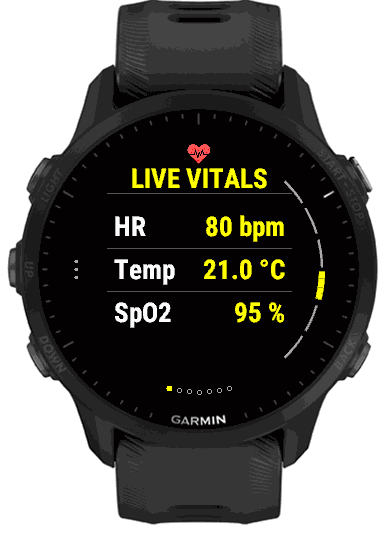
Your watch is already measuring some of heart rate, temperature and blood oxygen. Live Vitals shows the latest reading of each one your watch provides, and a page per measurement with the last 24 hours as a graph.
What it shows
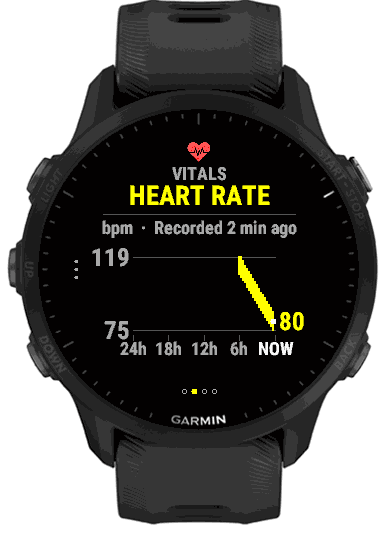
The Live Vitals page lists the latest reading of each vital you have switched on: HR, Temp and SpO2. Press START to open a page for each. A page shows the reading, how long ago it was recorded (“Recorded 2 min ago”), and a graph of the last 24 hours with its highest and lowest values. Press DOWN for the next vital and BACK to return.
The numbers come from the history your watch already keeps. EmergencyAid does not start any measurement of its own and does not store anything.
Heart rate
Your latest heart rate in beats per minute, and the lowest and highest over the last 24 hours. A heart rate that is unusually high or low for you can be an early signal worth mentioning to a responder, even before there are other symptoms.
Temperature
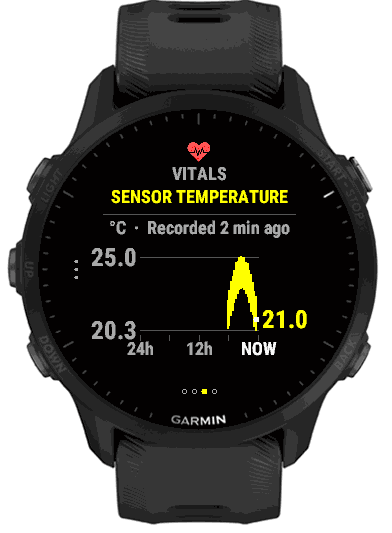
The reading of the watch’s temperature sensor, labelled Sensor Temperature on its page, in °C, with its 24-hour range. It is a reading at your wrist, not a core body temperature from a thermometer, so treat it as a trend, not a clinical fever check.
Blood oxygen (SpO2)
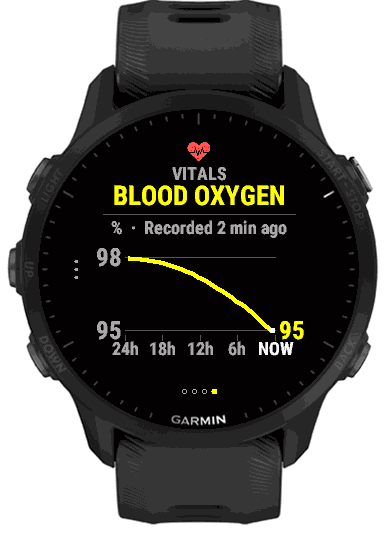
SpO2 is peripheral oxygen saturation: the percentage of oxygen your red blood cells are carrying, estimated by shining light through your skin (pulse oximetry). Healthy readings are typically around 95–100%. Persistently lower readings can point to a breathing or circulation problem worth mentioning. As with the others, you get the latest reading and the 24-hour range.
When there is nothing to show
A vital is shown only when you have it switched on in Settings and the watch has a reading for it from the last 24 hours. Anything else is left out, so the card never shows a blank or a made-up number. If none of them has a recent reading, the Live Vitals page is left out of the card altogether.
Which vitals your watch records, and how often, depends on the watch model and on your Garmin settings: for example, whether all-day heart rate or the pulse oximeter is turned on. A watch with no temperature or SpO2 sensor simply never shows that vital, and the rest still appear.
What Live Vitals does not do
EmergencyAid does not show ECG history, and it does not detect falls or crashes. Garmin builds those into the watch’s own system and Garmin Connect, and does not make them available to apps like this one. If you rely on fall or crash detection, it works on your watch independently of EmergencyAid.